

from surface to space
APRIL 2024
In the decades following the Second World War, a significant shift occurred within artistic practice as numerous artists began to challenge and ultimately expand the traditional definition of painting. No longer confined to the flat, rectangular surface of the canvas, painting evolved into a dynamic field of inquiry, one that intersected with space, materiality, gesture, and the very conditions of artistic production. This expanded notion of painting sought to dissolve boundaries, engaging with architecture, environment, and the viewer in increasingly complex ways. Echoing this historical trajectory, in 2019 Tate Modern presented a landmark exhibition that brought together European artists who had redefined painting during this period, emphasizing practices that moved beyond the limits of the canvas and into the realm of lived, spatial experience.
Building upon this legacy, we have curated a selection of recent works by Daniel Santolo and Nikolay Morgunov, artists whose practices continue to interrogate the relationship between surface, material, and space. Their work foregrounds the physical conditions that both contain and extend the artwork, opening a dialogue around presence, absence, and the viewer’s sense of belonging within a constructed environment. Through their distinct yet complementary approaches, both artists invite us to reconsider how space is not merely a backdrop for art, but an active and inseparable component of it.
Titled From Surface to Space, the exhibition traces a conceptual and material journey, from the traditional language of painting toward its expanded, transformative potential. Rather than presenting painting as a fixed or static medium, the exhibition frames it as a fluid and evolving practice that extends into both physical and conceptual dimensions. It is, at its core, an invitation: an open-ended proposition that encourages contemplation, curiosity, and a heightened awareness of how matter, form, and space interact. The works on view do not impose singular interpretations; instead, they create a framework within which viewers can explore their own perceptual and emotional responses.
Operating at the intersection of installation, photography, painting, and sculpture, Santolo and Morgunov embrace an intentionally unclassifiable practice. Their works resist categorization, instead existing in a state of productive ambiguity that engages both the viewer and the surrounding space. This approach gives rise to fundamental questions: Is empty space an integral part of the artwork, or merely its context? Can an installation exist independently as a self-contained piece, or is it always contingent upon its environment? At what point does an artwork truly begin and end within the space it occupies?
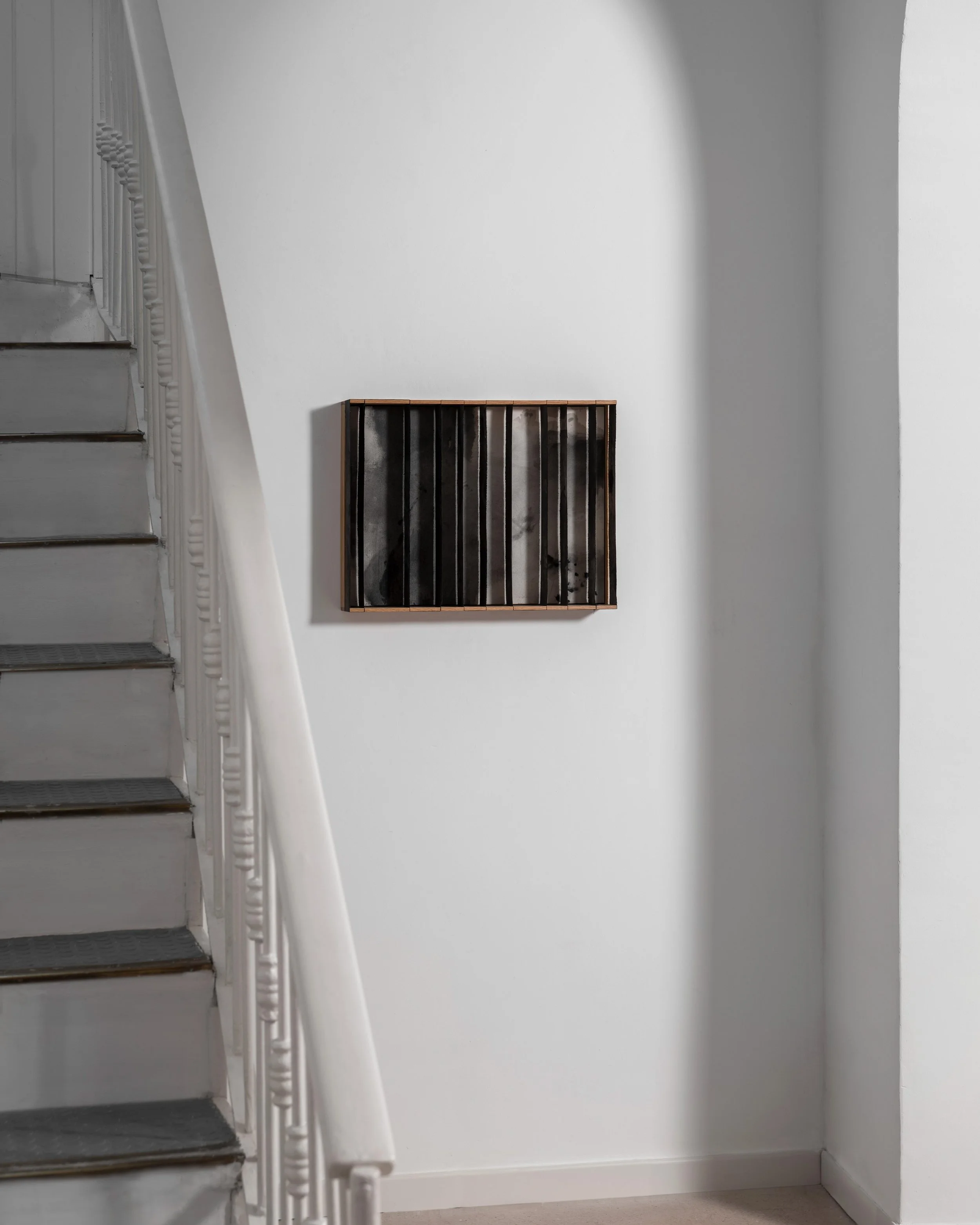
Nikolay Morgunov (Moscow, Russia) approaches these questions through a deeply spatial and material practice that physically intervenes in the exhibition environment. His sculptural paintings extend outward, incorporating the surrounding space as an essential element of the work. By using plastic threads, Morgunov “draws” within negative space, transforming absence into a tangible, perceptible form. In other works, he employs wood to construct volumetric structures that push beyond the traditional limits of the canvas, creating objects that demand to be experienced from multiple vantage points. This emphasis on movement and shifting perspective encourages viewers to navigate the work physically, transforming observation into an ակտիվ, embodied experience. In doing so, Morgunov not only expands the language of painting but also redefines the role of the viewer as an active participant in the construction of meaning.
Daniel Santolo (Caracas, Venezuela), by contrast, explores space through a more intimate and emotionally charged lens. His practice often takes the form of installations that resemble sculptural arrangements, which he then captures through photography, blurring the boundaries between ephemeral experience and fixed image. Santolo’s work is rooted in symbolism and affect, using everyday objects arranged in still-life compositions to evoke personal narratives and collective memories. These objects, though familiar, are imbued with layered meanings that transcend their ordinary function. In the context of this exhibition, Santolo presents an installation that reflects on themes of migration, displacement, and the fragile construction of identity, alongside a photograph documenting one of his most minimal gestures: two dry leaves delicately intertwined. This subtle yet poignant image encapsulates the artist’s ability to convey complex emotional states through simplicity and restraint.
Throughout From Surface to Space, viewers are encouraged to move freely within the exhibition, engaging with the works from multiple angles and under shifting conditions of light and perception. This physical navigation becomes an integral part of the experience, reinforcing the idea that meaning is not fixed but continuously shaped through interaction. The exhibition ultimately functions as a space of inquiry, a kind of open sanctuary where questions are not only posed but sustained. By moving beyond surface-level aesthetics, it invites viewers to immerse themselves in the deeper emotional and spatial dimensions of the works, experiencing art not as an object to be observed, but as a phenomenon to be inhabited.




inquire
Opening Hours
From Tuesday to Friday from 11am to 7pm.
Saturdays from 11am to 2pm.
C/ de Trafalgar, 32. Ciutat Vella, 08010 Barcelona