
COSMOS
Emilia Estrada, samuel sarmiento & luis renteria
NOVEMBER 2026 - february 2027
Cosmos refers to the universe understood as an ordered whole, a system in which different elements are interconnected and acquire meaning through their relationships. The word derives from the Greek kósmos, which encompassed the ideas of order and harmonious arrangement. Embedded in the term is a particular way of understanding the world: the belief that, amid the diversity of its elements, an underlying structure can be observed, interpreted and understood.
In the nineteenth century, Alexander von Humboldt adopted this concept as the title of his work Cosmos, published in five volumes between 1845 and 1862. Drawing on decades of research and exploration, including his travels across the Americas, Humboldt sought to bring together knowledge of celestial and terrestrial phenomena within an interconnected vision of nature. For him, understanding the universe meant attending to the relationships between its elements, from geological formations and plant life to the stars and the forces shaping the natural world.
Humboldt’s project reflected an ambition to understand the world through observation, classification and scientific inquiry, finding connections across an immense diversity of phenomena. Yet the desire to gather and organise knowledge also raises questions about who establishes the categories through which reality is understood, and which forms of knowledge remain outside them.
In the context of the conquest and colonisation of the Americas, naming territories, species and peoples became part of a process of appropriation, incorporating existing realities into European linguistic, scientific and cultural systems. Naming made these places and beings legible within a new order, often displacing the names, narratives and knowledge of the communities that had inhabited them for generations. The title Cosmos draws on this tension between the desire to understand the universe and the impulse to organise it according to a particular system of knowledge.
From this perspective, the exhibition brings together the practices of Samuel Sarmiento, Luis Rentería and Emilia Estrada. Working across distinct materials and artistic languages, the three artists explore the ways in which knowledge is constructed, transmitted and legitimised. Their practices engage with mythology, memory, cultural traditions and systems of representation, examining how these shape our perception of the world and our relationship with what remains unknown.
Samuel Sarmiento, a Venezuelan artist based in Aruba, works primarily with ceramic sculpture. Drawing on local mythologies, Caribbean oral traditions and narratives shaped by colonial history, extractivism and migration, he creates allegorical objects in which human and animal figures coexist with fantastical elements. His sculptures sustain stories and forms of knowledge passed down through generations, drawing on imaginaries connected to diverse territories and identities. In his practice, mythology becomes a way of exploring how communities interpret their surroundings and develop their own narratives about the world.
Luis Rentería, a Mexican artist who lives and works between Barcelona and Guadalajara, develops a practice that combines textile art, traditional techniques and references to folk art. His woven works incorporate materials, stories and symbols drawn from different cultural traditions, creating a language in which fiction, fantasy and memory connect territories and temporalities. Through these associations, Rentería explores how objects and images transmit knowledge, and how cultural imaginaries evolve as they move between contexts. His works open up a space in which symbols, narratives and materials contribute to alternative ways of understanding reality.
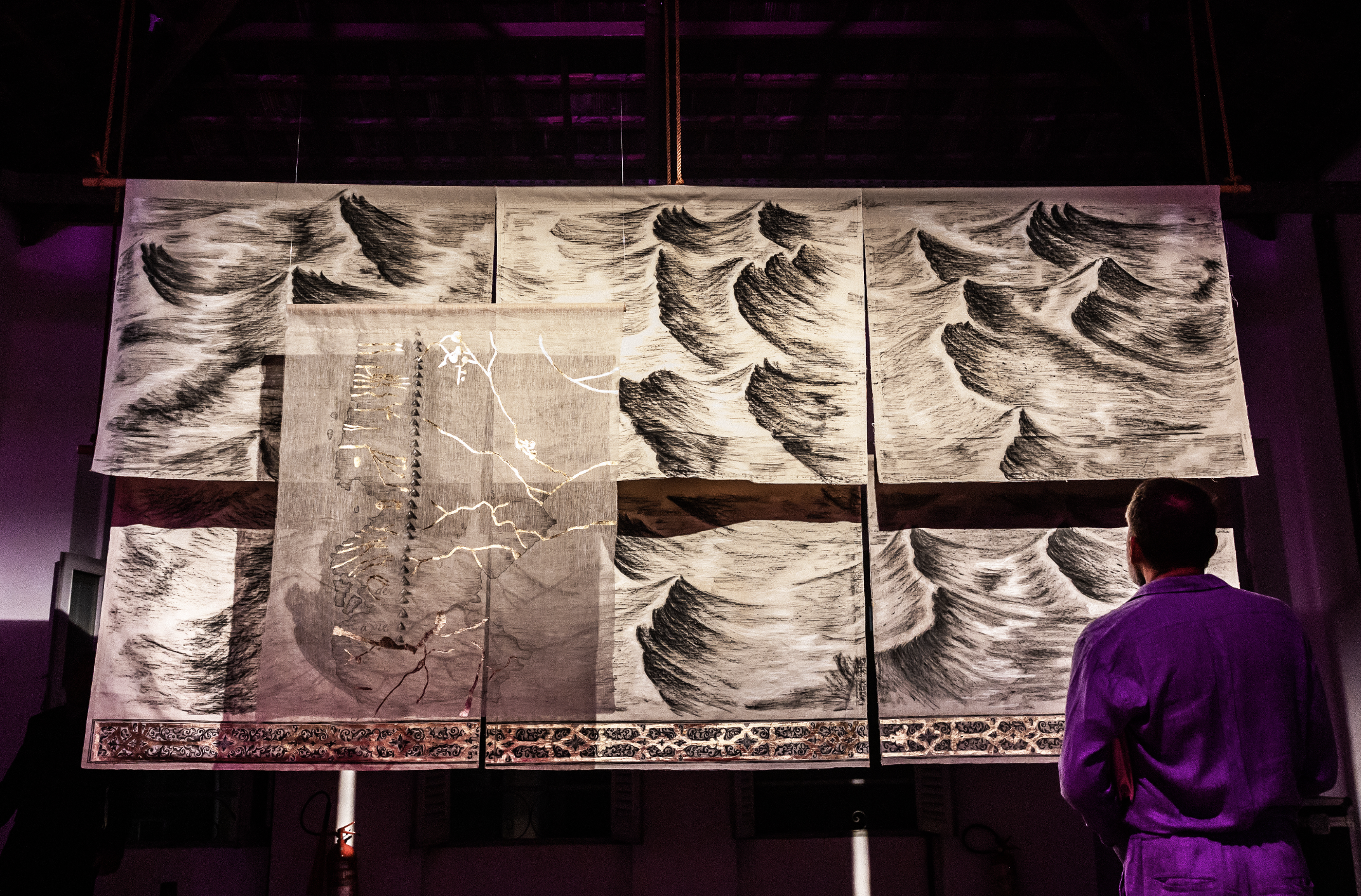
Emilia Estrada, an Argentine artist and researcher based in Rio de Janeiro, works with drawing, installation and archival research. Her practice examines terrestrial and celestial cartography as systems of representation shaped by power, occupation and territorial appropriation. In her recent work, the Moon and the mapping of the cosmos become points of departure for questioning how historical narratives are constructed, and how science, mythology and colonial imagination intersect. Her works investigate the instruments and frameworks through which the universe is observed, measured and represented, considering the forms of knowledge they produce and the limits they establish around what can be understood.
Through these practices, Cosmos reflects on the ways in which we name, classify and represent the world. The exhibition considers how systems of knowledge shape our relationship with the unknown, and how certain interpretations of reality have acquired authority over time. Rather than seeking to contain the universe within a single order, the works make room for other ways of knowing, in which memory, imagination, oral traditions and relationships with the land create different connections between the beings and worlds we inhabit.

emilia estrada INFO
By María Elena Pombo.
7 panels (made with deadstock silk organza, corn starch, cassava starch, potato starch,water, glycerin, vinegar).
Abya Yala:
(noun, Kuna]
1. Land in its full maturity.
2. Land of vital blood.
'Abya Yala' was the word used by the Kuna people of present-day Panama and Colombia to refer to their territory. Since the 1970s it has been recommended by various Indigenous groups as a decolonial term for the American continent. Starches of Abya Yala is an ongoing research project using corn, cassava, and potatoes as a starting point to understand the past, present, and future of this territory and the modern world at large.
These three plants were some of the most important food-sources for the origina linhabitants of Abya Yala. Considered deities, they are intertwined in countless origin stories of the people from the Meso-American, Caribbean-Amazonian, and Andean regions respectively. Corn, cassava, and potatoes were also important protagonists in the colonization experience. Perceived by Spanish colonizers as the "wheat" of the original inhabitants of these territories, they incorporated them into their diets. Albeit with a big dose of suspiciousness, as they believed if they ate too much of them, they too would become "Indian." These three plants continue to be some of the most important crops today, being food staples worldwide and their roles also spread beyond our plates.
Increasingly to feed livestock and producing fuels and industrial products marketed as so-called sustainable options. The case of corn being particularly representative, as by 2015 only 10% of the corn produced in the USA was directly ingested by humans. A complicated puzzle we'll have to find ways of solving in the future. Pintura de Castas Almidonoides is an installation that is part of the ongoing project Starches of Abya Yala. It transforms and recontextualizes these plants into 7 pieces that use their starches. As such, they are meant to change over time, with death and re-birth as possibilities.
The installation borrows its name from the Pinturas de Castas (Caste Paintings), a genre of paintings from the late 1700s in the Spanish colonized Americas that depicted the mixing of races due to the intertwining between Spanish colonizers, local indigenous people, and enslaved African people. Pintura de Castas Almidonoides, reinterprets the human mixing illustrated in said paintings through these plants, by exploring 7 different combinations for these "starch races": Maiz con Maiz (Corn with Corn); Yuca con Yuca (Cassava with Cassava); Papa con Papa (Potato with Potato); Maiz con Yuca (Corn with Cassava); Maiz con Papa (Corn with Potato); Papa con Yuca (Potato with Cassava); 3 en 1 (Corn with Potato with Cassava).
Using the animist lens of the original inhabitants of Abya Yala and the humorist lens of the Spanish colonizers surrounding these plants as a vehicle to start alternative readings around the humans that anthropomorphized) them and the ones to come, beyond the hegemonic narratives that continue to envelope these conversations. The pieces are purposefully not easily identifiable, an invitation to the public to decipher their contents (or if it matters).

samuel
By María Elena Pombo.
530 bricks (made from corn, cassava, and potato starch, water, and baking soda) vacuum sealed in 89 plant-based plastic bags.
530 is part of the ongoing project Starches of Abya Yala. It is a participatory installation rethinking the ideas around monuments for the XXI century. It is comprised of 530 bricks made from corn, cassava, and potato starch. Some of the bricks are "pure", while others are "mixed", echoing the fact that while in some of the regions of the Americas one of these plants reigned supreme, in others they shared protagonism.
Each brick in this piece represents a year since 1492, when Christopher Columbus first arrived in Abya Yala, and until 2022, today. Representing years of history through bricks, with the intention to illustrate the infinite possibilities to re-organize and re-understand it. Visitors are invited to use these bricks to create their own structures, as a metaphor for the need to explore alternative readings around this date beyond hegemonic narratives. These bricks are meant to be recontextualized in each environment in which they exist, just as history is always recontextualized depending on the time and space from which it is evaluated.

LUIS
120 x 90 cm
Ed. 5 + 1 PA
By Suwon Lee.
To create Moonset, Suwon Lee defied the notion of productive time. Sitting, waiting and observing, she spent the stretch of the night’s end (or the morning’s beginning) photographing a gibbous moon as it set into the horizon, its waning glow reflecting off the North Atlantic Ocean below. Lee took the photograph in 2013, when she was passing through the volcanic oceanic island of La Palma, off the coast of north-western Africa. She was returning to her native Venezuela from Iceland, where she had been experimenting with photographs of the sun and its light, a focal point of her artistic practice since the mid-2000s. In Moonset, the sun remains a spectral presence. However, now its radiating light is mediated by its lunar companion and, subsequently, the surface of the sea, both reflections that puncture the condition of all-encompassing darkness. In capturing these phases, Lee enacts a process of measuring through the moon’s cycles.
- Excerpt from Madeline Murphy Turner, "The Measure of the Moon," in Night Fever: Film and Photography After Dark, edited by Shanay Jhaveri (Cologne: Walter Konig, 2024).


INQUIRE
Opening Hours
From Tuesday to Friday from 11am to 7pm.
Saturdays from 11am to 2pm.
C/ de Trafalgar, 32. Ciutat Vella, 08010 Barcelona